
Preparation for Colonoscopy
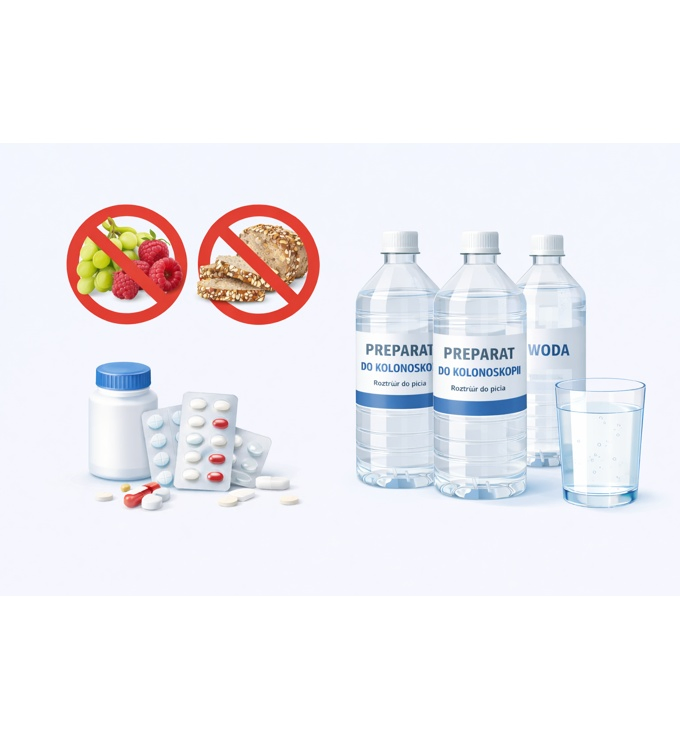
A thorough internal examination of the bowel requires it to be completely cleared of any food residue. This is achieved by using an appropriate preparation taken as directed. Frequent bowel movements are the expected response to the preparation. Towards the end of the process, the patient should be passing clear, liquid, yellow-colored fluid. When using a split-dose regimen (taken in two portions — the evening before and the morning of the procedure), the bowel movements on the second day are typically less frequent and shorter in duration than on the first day.
Several bowel cleansing preparations are available in Poland. At our center, physicians most commonly recommend Fortrans, which is the best-studied preparation and has been in use for many years, although other preparations may also be used.
PREPARATION INSTRUCTIONS:
To improve the quality of bowel preparation, it is recommended to add 500 mg of simethicone to each dose of the laxative — for example, Espumsan drops, 1 teaspoon (5 ml).
IMPORTANT:
1. Patients regularly taking medications (e.g. for arterial hypertension, heart disease, epilepsy, asthma, or other conditions) should take their usual morning dose on the day of the examination with a small amount of water — EVEN IF THE PROCEDURE IS BEING PERFORMED UNDER ANESTHESIA.
2. Diabetes — Patients with diabetes should inform the registration desk and additionally consult their treating physician or our center's anesthesiologist regarding preparation for the examination. Do NOT take oral antidiabetic medications if you are not eating at the same time.
- a) Metformin preparations: Metformax, Metformin, Siofor, Glucophage, Formetic, Avamina, Diabufor, Etform, Metcrean, Ranmet, Symformin, Zenofor, Combodiab, Depepsit Met, Eprocliv, Fordiab, Jamesi, Janumet, Juzimette, Lonamo Duo, Maymetsi, Matsigletic, Symetlip, Ristfor, Anvildis Duo, Eucreas, Gliptivil Combo, Ipinzan, Vinetso — the last dose should be taken no later than 48 hours before anesthesia.
- b) SGLT2 inhibitors: Jardiance, Synjardy, Forxiga, Xigduo, Segluromet, Invokana, Qtern — the last dose should be taken no later than 72 hours before anesthesia.
- c) GLP-1 analogs: Semaglutide (Ozempic, Wegovy); Dulaglutide (Trulicity); Tirzepatide (Mounjaro) — the last dose should be taken no later than 7 days before anesthesia.
- d) Liraglutide (Saxenda, Victoza) — the last dose should be taken no later than 2 days before anesthesia.
- e) Rybelsus — the last dose should be taken no later than 24 hours before anesthesia.
3. Patients taking blood-thinning medications:
- Do not discontinue acetylsalicylic acid preparations (e.g. Acard, Polocard, Acesan)
- New oral anticoagulants (Pradaxa, Xarelto, Eliquis, Lixiana) — discontinue on the day before the procedure and skip the morning dose on the day of the examination.
- Traditional oral anticoagulants (Acenocoumarol, Warfarin) — INR should be measured in the week preceding the examination: if the result is within the range of 2–3, no dose adjustment is necessary; if higher, consult your physician.
Patients at high thromboembolic risk, or those with a history of myocardial infarction or stroke, are strongly advised to consult their physician or our center's anesthesiologist before the procedure.
4. Pregnant women and breastfeeding mothers should consult their treating physician regarding preparation for the examination.
Please bring any relevant medical records to show the physician before the examination — these may include hospital discharge summaries, reports from previous endoscopic procedures, abdominal ultrasound, ECG, echocardiography, spirometry, or other investigations.

Colonoscopy Preparation
Educational videos for patients
featuring Prof. Michał F. Kamiński, MD, PhD,
courtesy of Recordati